June 10 - Written By: Leah Whatley, LPC-A

People have thousands of thoughts a day, and those reflections can be composed of positive and negative thoughts that impact our daily functioning. Individuals’ thoughts, emotions, and behaviors are greatly interconnected, and understanding how they impact each other can assist with one’s mental, physical, and emotional health. With all of these elements connecting, all it takes is one negative thought to change our emotions and behaviors, which is why it is important to know how to identify a negative thought and work towards creating healthy thought patterns to maintain a healthy mental well-being. By the end of this discussion, readers should be better equipped to understand the impact that thoughts have on one’s mental health, identify unhealthy thought patterns, and improve positive thoughts.
The Impact of Thoughts on Mental, Physical, and Emotional Health
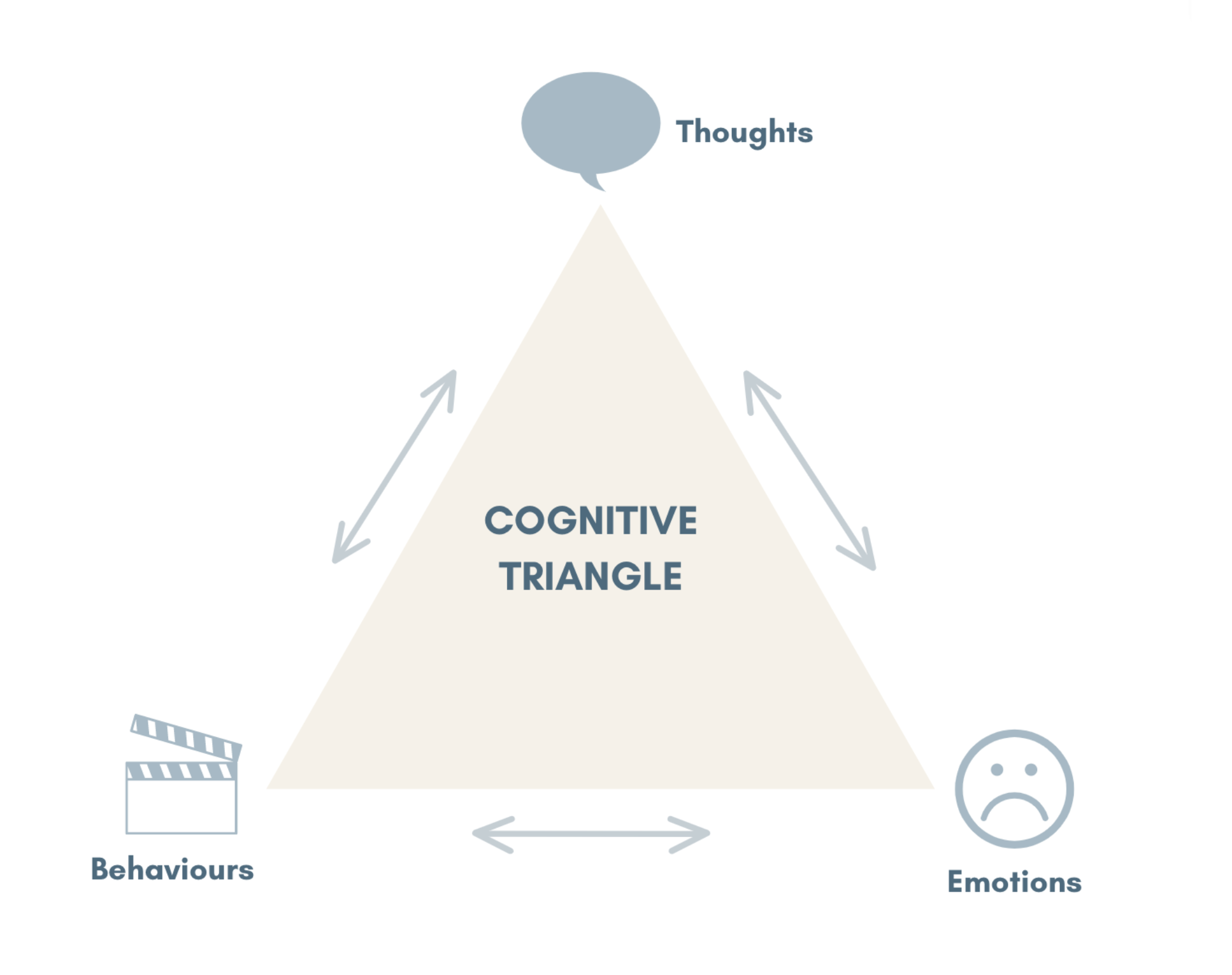
Thoughts play a crucial role in mental, physical, and emotional health, as they influence an individual’s beliefs, behaviors, and perceptions of different situations. In the 1960s, Dr. Aaron Beck understood the impact that thoughts, emotions, and behaviors had on each other, which led him to create Cognitive Behavioral Therapy and the CBT Triangle. This triangle helps individuals see the interconnections that happen between these three elements and is a beneficial tool to help others see how an event can influence our thoughts, behaviors, and actions, as well as take control of their mental health by breaking unhealthy negative cycles. Here is the Cognitive or CBT Triangle, and let’s try to practice utilizing it. How you can practice this is by identifying a situation, then labeling the three corners with what your thoughts, emotions, and behaviors would be. Next, analyze how each element is impacting the others, and work on challenging and/or reframing to change the unhealthy pattern.
Below is an example to show how individuals can utilize this tool to take control of their mental health and to work on creating healthy thought patterns.
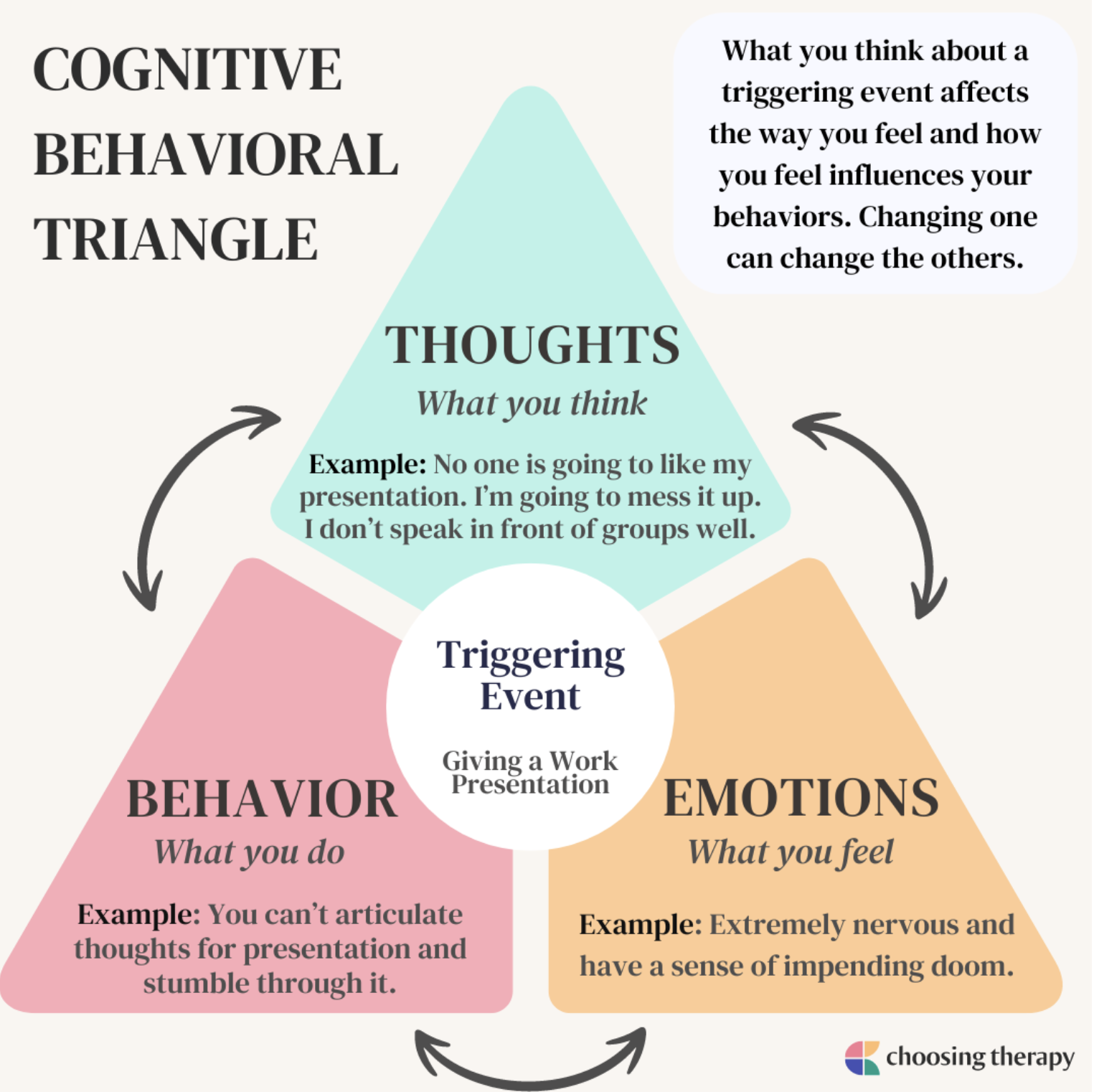
With this in mind, understanding how to utilize this tool can be essential in working towards healthier mental, physical, and emotional health. Negative thoughts can have a significant impact on overall well-being. They may affect mental health by increasing stress, anxiety, and other emotional challenges, which can lower quality of life. These thoughts can also contribute to physical health issues, such as fatigue, sleep concerns, or other stress-related symptoms. As mental and physical health are affected, emotional regulation may become more difficult, further influencing emotional well-being. Because mental, emotional, and physical health are closely interconnected, difficulties in one area often affect the others. This interconnectedness reflects the relationship between our thoughts, emotions, and behaviors. Learning about negative thoughts and learning skills to manage them is imperative to creating a better life quality and healthy mental, emotional, and physical health.
Cognitive Distortions
Negative thoughts are very common in daily life, and most of the thoughts are repetitive, which can negatively impact an individual even more. Learning about several different types of negative thoughts and understanding how to identify them can help individuals work towards challenging or reframing these thoughts, which can assist with decreasing negative patterns. In the 1980s, Dr. David Burns was inspired by Dr. Aaron Beck and wrote a book titled Feeling Good: The New Mood Therapy, which talks about Cognitive Behavioral Therapy or CBT concepts, cognitive distortions or negative thought patterns, how negative thoughts impact people, and how people can apply this information, as well as work towards managing these unhealthy patterns. Using his concepts, Burns identified ten main cognitive distortions or unhealthy thinking errors: all-or-nothing thinking, overgeneralization, mental filter, discounting the positive, jumping to conclusions, magnification/minimization, emotional reasoning, “should” statements, labeling and mislabeling, and lastly, personalization and blame. Below are the 10 cognitive distortions and their definitions.
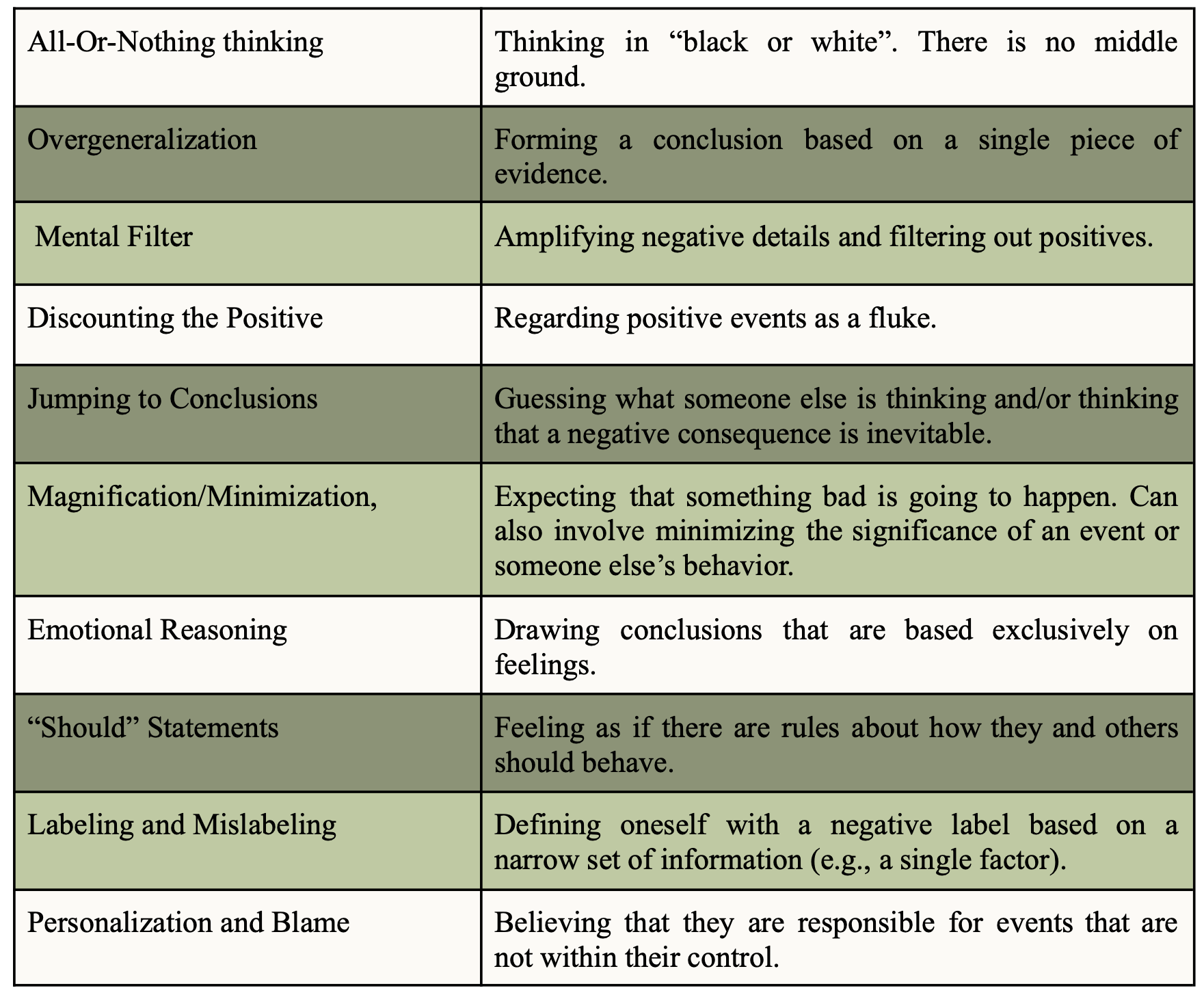
Looking at this chart, are there some thought patterns that you recognize? Learning how to identify these cognitive distortions should help individuals become aware of unhealthy thought patterns and help them with utilizing strategies to improve their positive thoughts.

Strategies to Improve Positive Thoughts
Positivity has shown multiple benefits, including improved physical health, mental well-being, and emotional health. (Rosenfeld, 2019) Positive thinking is immensely important when working towards a healthy mental well-being and is a large part of managing stressors. Depending on how we grew up and our environment, our thought patterns may lean toward either more negative or more positive. Regardless of which one you learn towards, you can still alter your thinking patterns and work towards a healthy state of mind with different strategies. After learning a couple of cognitive distortions and learning how to identify them, the next step is to be able to utilize different techniques that can improve your mental health and decrease negative thoughts.
One technique that was mentioned earlier is to challenge and/or reframe negative thoughts. With this skill, you have to first identify the cognitive distortion and identify what kind it is. An example of a cognitive distortion would be, “My friend said I was a good person… they must be saying that to be nice and they don’t really mean it.” After this thought appears, pause and understand that this is a cognitive distortion. To identify it, readers can look at the chart above for the ten common ones created by Burns or look up cognitive distortions, and a list of them should appear. This example is discounting the positive, and most people struggle with this negative thought pattern. Once you’ve identified that this is an unhealthy thought process, we can take a step back and challenge it, then reframe the negative thought. There are many ways to challenge and reframe cognitive distortions, but this discussion is going to focus on a basic way. Looking back at the example, “my friend said I was a good person… they must be saying that to be nice, and they don’t really mean it.”, lets work on challenging and reframing it. With this thought, ask yourself a couple of questions to challenge it.
Is there any evidence that this thought is true?
What makes me think this thought is true?
Is this thought realistic?
What is the worst-case scenario if this thought is true?
What is a more realistic scenario if this thought is true?
What is another way to look at this thought?
What could happen if I changed my thought process?
What would a friend or family member say if I told them this negative thought?
After challenging the cognitive distortion with some of these questions, you can work on reframing it as well. Below are some ways that one can reframe this cognitive distortion. Example: “My friend said I was a good person… they must be saying that to be nice and they don’t really mean it.”
This is a sweet friend, and I know they don’t have a hidden agenda, so I should take their compliment instead of assuming they are lying to me or pitying me.
I have had several people say that I am a good person or friend, so maybe I should see that others see this characteristic in me instead of thinking that I am not a good person.
Instead of thinking to the extreme that I am not a good person, I should focus on a middle ground, like I may not think I am a good person, but I am working towards being a better person.
My friend’s perspective counts, even if I think differently from them about myself.
If this friend said this about themself, what would I tell them?
There are many other ways to challenge and reframe your thoughts, but a good way to practice it is to focus on a positive outlook.
Other skills to work towards decreasing negative thoughts are to work towards becoming more optimistic and engaging in more positive thinking patterns. This can include seeing the glass half full instead of half empty, assessing and reflecting on your thinking patterns throughout the day, surrounding yourself with positive outlets, practicing positive self-talk, working on gratitude, and many more. Thinking positively can help us cope with stressors more, as well as improve our mental health. Below are some basic ways that you can start practicing positive thinking patterns to improve your mental, physical, and emotional health.
Surrounding yourself with positivity
Whether it is people who make you smile and bring out the best in you, or different environments that make you focus on the positive instead of the negative, who and what you surround yourself with will greatly impact your positivity and outlook on life.
Practicing mindfulness and gratitude
Acknowledging things, either small or big, that make you happy or that you are grateful for can shift your focus to a more positive perspective.
Exercising, yoga, meditation, and other practices that help ground you can boost healthy habits and your positivity.
Assessing and reflecting on your thought processes
This idea was addressed above when identifying cognitive distortions and unhealthy thought patterns. It can be helpful to assess your thought processes and reflect on how you can work towards changing unhealthy patterns.
Positive self-talk
Challenging or reframing any negative thoughts that come up about yourself with the above challenging questions can help boost your self-esteem and change your self-talk.
Utilizing targeted affirmations and focusing on positive things about yourself. There are many more ways to improve one’s positivity, but these are some techniques that you can start with.

Closing Thoughts
To end, as humans, we have thousands of thoughts a day, and they can greatly impact our mental, physical, and emotional health. By understanding how thoughts can impact our daily functioning and life quality, identifying negative thought patterns or cognitive distortions, and working towards changing our unhealthy thought patterns to a more positive way, we can improve our mental health. I hope this discussion was beneficial and assisted in showing you the importance of having healthy thought patterns. If you or someone you know is greatly struggling with their thoughts, whether it be anxious thoughts, depressive thoughts, intrusive thoughts, or another unhealthy thought pattern, multiple talented therapists can help provide more techniques and strategies. Our team at Endeavor Counseling Associates is ready to help and would love to provide more techniques and strategies for your needs.
References
Burns, D. D. (1980). Feeling good: The new mood therapy. Signet Books.
Parsamanesh, P., & Vysochyn, M. (2024). A psychological exploration of the power of our mindset and its influence on physiological health. Cureus, 16(1), e52505. https://doi.org/10.7759/cureus.52505
Rosenfeld, A. J. (2019). The neuroscience of happiness and well-being. Child and Adolescent Psychiatric Clinics of North America, 28(2), 137–146. https://doi.org/10.1016/j.chc.2018.11.002
Shafir, H. (2021, November 10). CBT for anxiety: How it works & examples. Choosing Therapy. https://www.choosingtherapy.com/cbt-for-anxiety/
What is cognitive behaviour therapy (CBT) based trauma therapy? (2024). Exhale Psychology Centre Brisbane.